If you run a business, at some point in the last year you probably typed your own company name into ChatGPT. And either it had no idea who you were, or it recommended two of your competitors instead. This guide is for founders, CMOs and marketing leads who are past the “should we care about this” question and want the actual mechanics: how large language models decide who to name in an answer and how long it realistically takes to show up.
The shift is already showing up in the numbers. In the first four months of 2026, roughly 68% of Google searches ended without a single click, and when an AI Overview appeared, that number rose to 83%. Separate conversion data from Seer Interactive and First Page Sage puts AI-referred traffic conversion rates between 10.5% and 16.8%, against roughly 1.76% for traditional Google organic traffic. Fewer clicks are happening at all, and the ones that do happen convert far better which is exactly why being the business an AI names is worth solving now.
What “getting cited in an LLM” means
Getting cited means ChatGPT, Gemini, Claude, Perplexity, or Google’s AI Overviews names your business, quotes your data, or links to your page while answering someone’s question.
It is not the same as ranking on page one of Google. A page ranking #1 can be skipped entirely, while a page ranking #47 gets quoted, because the model isn’t sorting a list of links, it’s assembling one answer from whatever it can read, verify and trust.

You cannot buy a citation. There is no ad auction and no agency can promise a mention on a specific date for a specific query. What you can control is whether your business is legible enough, verifiable enough and quotable enough that the model chooses you over the competitor sitting in the same result set.
How LLMs decide who to cite
Training data vs. live retrieval
Models work two ways, and it changes what you should fix first.
In pure training-data mode, the model answers from what it learned during training: your broader footprint across Wikipedia, review sites, press and forums matters more here than your own website.
In browsing or search mode (ChatGPT search, Perplexity, Google AI Overviews), the model fetches and reads live pages, so your own site’s crawlability and structure become the deciding factor.
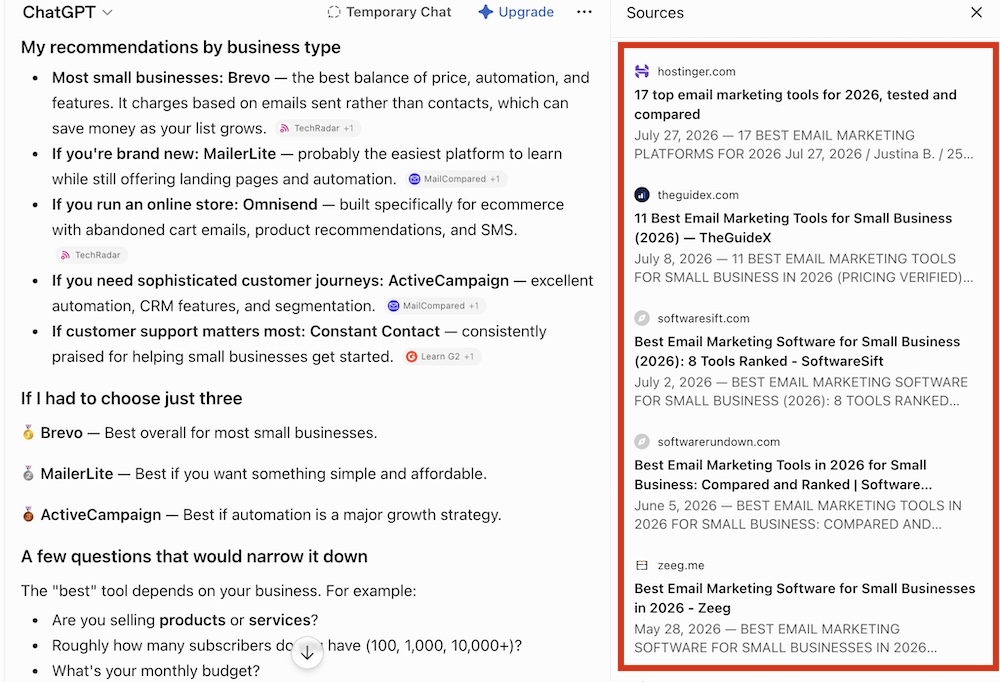
Across dozens of documented citation patterns, four things consistently separate the businesses that get named from the ones that get skipped:
- a crawlable site,
- a clearly defined entity,
- content written as a direct answer,
- a third-party footprint that backs up the claim.
Miss any one layer and a competitor with all four gets picked instead. Size and ad budget don’t override this.
Which sources actually win AI citations
Here’s the uncomfortable part: a large share of citations aren’t business content at all. An Ahrefs analysis of the 1,000 pages ChatGPT cited most often in a recent tracking period found that 67% were what its researchers call “dead” citations: Wikipedia articles, organizational homepages, app-store listings. These are pages no outreach or content campaign can realistically earn.
Only around 32% of citations go to page types a business can actually build for: educational how-to content, reviews, news coverage and blog articles.
Recency is close to non-negotiable. The same research found 89.7% of cited pages had been updated within the past year, and 60.5% were originally published within the last two years. A page that’s thinner but current will often beat a stronger page nobody has touched since 2023.
The short version: what to actually do to get your brand cited in AI
If you only have a week to start, this is the detailed checklist further down fills in the rest.
- Confirm GPTBot, OAI-SearchBot, ClaudeBot and PerplexityBot aren’t blocked in robots.txt, and that your key pages render without relying on JavaScript.
- Add an llms.txt file at yoursite.com/llms.txt — a fast-growing convention that tells AI systems who you are, what you do, and which pages matter most.
- Add Organization and FAQ schema to your core pages so the facts don’t have to be guessed.
- Open every key page with a 40–60 word answer that fully resolves the question, before any context or backstory.
- Publish numbers you actually own: a survey, a benchmark, usage data, instead of a general claim; a specific stat is citable, a vague one isn’t.
- Update your highest-value pages at least quarterly, with a visible “last updated” date.
- Put effort into the citable third: comparison and review content, trade press outreach, and honest participation in the community threads where your buyers already ask these questions.
- Wait for 4–8 weeks: AI citations need time to appear in AI answers.
Why you’ll see wildly different stats on this topic
Search around and you’ll find claims that AI Overviews appear in 13.7% of queries, and others claiming 51.5%. Neither figure is wrong: they’re measuring different things.
A 2026 academic survey analyzing 55,393 trending queries found the overall AI Overview trigger rate was 13.7%, but it jumped to 64.7% specifically for queries phrased as questions; a separate study sampling a different query mix found AI answers on 51.5% of searches. Different samples, different conditions, different numbers.
The same caution applies to the often-quoted “GEO boosts visibility by up to 40%” figure from the original Princeton/Georgia Tech/IIT Delhi study. The study tested 10,000 queries and found adding statistics, quotations and citations lifted visibility by 30–40%.
But a later academic critique of that paper points out the gain was measured among sources already placed in the model’s context. In other words, it measures how to win once you’re already a candidate, not how to become one from zero.
That’s an important distinction: content quality decides who wins among the shortlisted; crawlability and entity signals decide who makes the shortlist at all.
The AI-visibility checklist
Here is the order we work through with clients, roughly matching the impact-to-effort ratio of each fix.
| Layer | What it means | Quick action |
|---|---|---|
| Crawl access | AI crawlers can only cite pages they can actually read. | Confirm GPTBot, OAI-SearchBot, ClaudeBot and PerplexityBot are allowed in robots.txt, and that key content isn’t hidden behind JavaScript. |
| Entity clarity | The model needs one consistent picture of who you are. | Match your business name, description and details across your site, LinkedIn, Crunchbase, directories and Wikidata (if eligible). |
| Answer-first content | Models lift short, self-contained answers, not narrative intros. | Open each page with a 40–60 word direct answer to the exact question, before any backstory. |
| Structured data | Schema removes the guesswork for machines. | Add Organization, FAQ and Service/Product schema to your core pages. |
| Third-party proof | Models trust claims that other sources repeat back. | Build reviews, press mentions and comparison articles that name you, not just links to you. |
| Monitoring | Citations shift as models retrain and re-crawl the web. | Re-test your target queries in ChatGPT, Perplexity and Gemini monthly, and refresh pages that go stale. |
What this looks like in practice: two client stories
Frameworks are easier to trust with real numbers behind them. Both projects below combined the checklist above with ongoing content work over several months.
First one: a crypto exchange invisible to AI search
Our client, a crypto exchange in Georgia, already had organic traffic and paying customers, but ChatGPT and Gemini simply didn’t know it existed: a technical block meant AI crawlers couldn’t read the site’s key pages at all, even though human visitors saw them fine.
We ran a technical audit, removed that wall with the client’s engineering team, and rebuilt the content strategy around direct, up-front answers instead of keyword-first articles.
Digital Broccoli: from traffic to a citable source
Digital Broccoli, an e-learning brand, had steady blog traffic that had plateaued because the site structure was holding growth back and the content was written to attract clicks, not to answer a question completely.
We rebuilt the URL structure without losing existing traffic, then shifted every new article to read the way a subject-matter expert would answer.
| Metric | A crypto exchange | Digital Broccoli (e-learning) |
|---|---|---|
| Starting point | Had traffic, but AI crawlers couldn’t read key pages | Steady blog traffic, but content wasn’t written to be quoted |
| Fix | Removed the technical wall blocking AI crawlers; rebuilt content as direct answers | Rebuilt site structure and URLs; rewrote content the way an expert answers a question |
| Result | Top-3 AI recommendation in 6 months; 100+ AI citations; 360% organic growth | 150% growth in AI mentions; $100,000 in tracked organic sales |
The mistake almost every business makes in GEO/AEO
The most common assumption we hear is: “we already rank well on Google, so AI will cite us too.” That link is breaking.
Industry tracking from BrightEdge found the overlap between Google’s top-10 organic results and AI citations fell from roughly 75% in mid-2025 to somewhere between 17% and 38% in early 2026.
The reason is structural: Google’s ranking rewards backlink authority and overall domain strength, while an AI engine rewards whichever paragraph answers the question most completely and can be lifted out of context cleanly.
A page can dominate its keyword and still never get quoted, because nothing on it is written to stand alone as an answer.
How long before you see the first results from your GEO/AEO strategy
Expect two different timelines running in parallel. Narrow, low-competition queries can start surfacing new or refreshed content within 3–5 days of publishing, since some AI engines browse live pages.
Consistent visibility across ChatGPT, Gemini, Claude and Perplexity for your core commercial queries typically takes 2–4 months of sustained work, similar to a traditional SEO timeline, because entity trust and third-party corroboration build up gradually rather than overnight.
How to tell if your GEO/AEO strategy is actually working
Track your AI visibility the same way you’d track rankings, just with different tools. Manually query ChatGPT, Perplexity, Gemini and Google AI Overviews every month with the exact questions your buyers would ask: “best [category] for [audience]”, “who should I use for X,” and log whether your brand appears, in what position, and next to which competitors. A simple spreadsheet works fine to start; the point is catching the shift before a competitor locks in the spot you could have had.
If you want more data, use Ahrefs, Semrush or Otterly.
FAQ
Can I pay ChatGPT or Google to cite my business?
No. There is no paid placement mechanism for AI citations: authority has to be earned through the technical, entity and content work above.
Do I need to rank #1 on Google first?
No, and increasingly it doesn’t help much on its own. The overlap between top Google rankings and AI citations is shrinking, so ranking well is a starting advantage, not a guarantee.
Is this the same as SEO?
It builds on SEO but isn’t identical. Traditional SEO optimizes for ranking a link; this optimizes for being the extractable, verifiable answer. Crawlability, schema and third-party proof matter more here than backlink volume alone.
Does my industry change the approach?
Yes. The Princeton GEO study specifically found optimization effectiveness varies by domain, which is why a generic template rarely performs as well as a strategy built around how your category actually gets discussed online.
If you want a clear picture of where your business currently stands and what an AI system says about you right now versus your competitors, request an audit from Linkrel Agency, and you’ll hear back with initial observations within 48 hours.